
Today is Ernest Hemingway’s 126th birthday, and that means every writing nerd on the internet is pushing out pieces today. For good reason, too, Papa-Hemdawg is the man.
Hemingway was an adventurer. He drove an ambulance in the Italian theater of World War I, covered the Spanish Civil War on the ground, and had other once-in-a-lifetime moments repeatedly across the Globe.
He also won the Nobel Prize in Literature in 1954, which to me is his most incredible achievement.
Needless to say, most writers agree that Hemingway is on another level. As such, many writers are spending the day discussing their favorite Hemingway works. While I could throw my poorly written piece onto the pile, I want to do something different, and that is to look at Ernest Hemingway’s advice to writers.
While Hemingway was superstitious about discussing his work in too much detail, he did leave crumbs of knowledge throughout his work and correspondence. These crumbs were collected into a book called Ernest Hemingway on Writing by Larry W. Phillips.
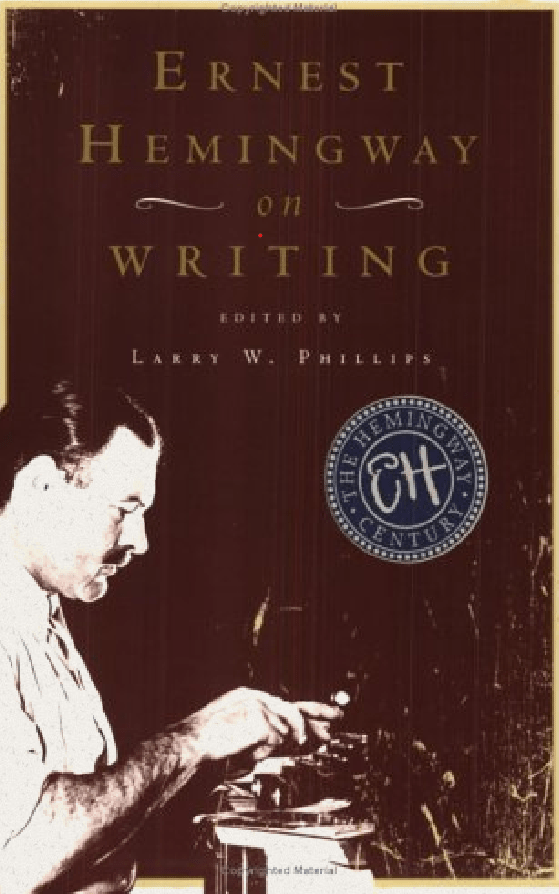
This is not going to be a book report. It is just some thoughts after reading the book.
I’ve always been a fan of simple and direct prose, even before knowing anything about Hemingway. After reading this book, I feel confident in that writing style. He also stresses simple punctuation, which is something I try to do as well. I picked the habit up from Kurt Vonnegut, who had some interesting thoughts on using advanced punctuation:
“Here is a lesson in creative writing. First rule: Do not use semicolons. They are transvestite hermaphrodites representing absolutely nothing. All they do is show you’ve been to college.”
Hemingway’s thoughts on symbolism in writing were also a treat, as seen here:
“Then there is the other secret. There isn’t any symbolism. The sea is the sea. The old man is an old man. The boy is a boy, and the fish is a fish. The sharks are all sharks, no better and no worse. All the symbolism that people say is shit. What goes beyond is what you see beyond when you know.”
I laughed so hard when I read this, but it lines up with the way Hemingway writes. Symbolism is shit.
I appreciate it when such a talented writer champions plain writing. Every time I try to read a New Yorker, I just keep rolling my eyes.
While all of these tips are good, in the end, Hemingway’s real secret to being a good writer is as follows:
“…real seriousness in regard to writing being one of the two absolute necessities. The other, unfortunately, is talent.”
Shit. Well, there goes my plans.
While my talent may be lacking, there is plenty to take from this book. There is Everything from punctuation guidance to work habits and rewriting tips.
While all of this advice is great, this book also does a fantastic job of putting together Hemingway’s philosophy on life. As any good writer knows that philosophy needs to intersect with your work to truly make your reader feel. Hemingway’s thoughts on life influencing writing are the best part of this book.
When it comes to Hemingway’s relationship with writing, he shares the same thought as I do, and that is that some of us have to write, whether we get paid or not, just to be happy.
“I have to write to be happy, whether I get paid for it or not. But it is a hell of a disease to be born with. I like to do it. Which is even worse.”
Honestly, same.
“…writing is something that you can never do as well as it can be done. It is a perpetual challenge, and it is more difficult than anything else that I have ever done—so I do it. And it makes me happy when I do it well.”
Writing something that I can step back and say “holy shit, this is good” is a high like no other. Writing is always a challenge, and I’ll always feel like I can only do it to my satisfaction occasionally. When I get the magic going, though, I’m an irresistible force. Taking English classes for four years can humble a man, but I know when I’m on, I have something.
I love writing. I have folders full of stuff piling up. That’s why I am writing here, for the love of the game.
Having a place to put thoughts down is an incredible feeling. Honestly, I only do it for myself, but if readers can take something from my experiences that helps them in any way or gives them even the faintest feeling of emotion, that is the best feeling in the World.
Speaking of an audience, as previously stated, I only write for myself. When I do write, however, my loved ones sometimes get to see inside of my mind in a way I am incapable of sharing through verbal communication. In that way, I do try to write for my loved ones. Hit us with it, Ernest:
“I believe that basically you write for two people yourself to try to make it absolutely perfect, or if not that, then wonderful. Then you write for who you love, whether she can read or write or not, and whether she is alive or dead.”
When you start writing, even though you will probably suck at it, the emotion is raw. It’s real, and it’s you, and the fact that you haven’t taken an English composition class yet doesn’t matter. My mom bought me a typewriter when I was all of 12 or 13, and the things that came out of that machine were probably some of my best work. If I could go over that work today and spruce it up, I imagine it would be great. You can never capture the emotion of writing in the moment unless you do so. It’s the best time to pour it all out, you can edit it later.
This includes positive experiences as well. I have traveled extensively across the US and barely wrote about it while I was doing so, something I deeply regret. I’m hopeful that once my wife and I’s business is stable that I can revisit the idea of traveling. I imagine if I could ever finish remodeling my back bedroom to move her brother in, I would be able to disappear for a week or two.
Not writing at the time is something that will hang over me until I can right the wrong. Someday…
“…whatever success I have had has been through writing what I know about.”
I wrote to escape having two terminally ill parents. Writing saved my life, and recommitting to it is only enhancing my life in 2025. This piece is not only about Ernest Hemingway, but it is also about how reading his thoughts has lit a fire under my ass that I haven’t felt in some time.
Ernest Hemingway reintroduced me to my temptress, and I am giving in.
Well, as Ernest Hemingway once said, I need to get back to trying the unusual experiment of a writer writing, even though it “will probably turn out to be vanity.”
Stay Crescent Fresh, everybody
J.T.C.

 Letters to Nobody
Leave a comment